When the Operative's Phone Becomes the Evidence File
An undercover operation can survive a dangerous night and still fail in court if nobody can prove what was said. Agency-operated field platforms are changing how infiltration evidence is captured, protected and defended.
Key findings
- ›Undercover operations fail in two ways: the operative is exposed, or the evidence cannot be proved in court.
- ›Agency-operated command and control gives supervisors live awareness of enrolled field devices instead of relying on after-the-fact recollection.
- ›Timestamping and hashing every capture off-device is what turns a recording into a defensible exhibit.
- ›The same capability that protects an operative can be abused without written authorisation, minimisation, retention limits and independent oversight.
- ›On-premise deployment, delivered source code and independent audit are the practical controls that let a court trust the tooling.
An operation can run for eleven months, produce the arrests, and still collapse at trial. Not because the intelligence was wrong, but because nobody could prove where it came from.
That is the unglamorous centre of undercover work. The operative inside a trafficking network or a narcotics supply chain is the only person who hears the conversation — and human memory, months later, under cross-examination, is a weak exhibit. The recording that should have settled the question is on a phone that was in a locker, then in an evidence bag, then in a drawer, with no record of who handled it in between.
Two failure modes, one system
Undercover operations fail in two ways. The operative is exposed, or the evidence is unprovable. Most field technology addresses one and ignores the other.
Agency-operated platforms such as Undercover Agent are built around the premise that both problems are the same problem: the agency needs continuous, defensible awareness of what its own authorised devices captured and where its people are.
The architecture is straightforward. Each operative carries an agency-issued Android handset running a dedicated application. That handset connects to a Command and Control dashboard operated exclusively by the acquiring agency, deployed on the agency's own infrastructure. The agency receives complete source code, can commission an independent technical audit, and runs the system itself rather than renting a view into someone else's cloud.
What the dashboard actually does
Oversight. Every enrolled device reports status, connectivity and location. Supervisors see the operation as a live picture rather than a set of phone calls after the fact.
Authorised collection. Calls, messages across messengers, media, file and application inventory, and — where lawfully authorised — on-demand ambient audio and camera capture. Collection is configured by the agency, scoped to the operation, and tied to the case file.
Agent protection. Live location awareness for designated command staff, check-in discipline, emergency alerts and rapid-response coordination. When an operative's cover is at risk, minutes matter and a missed check-in should trigger an alert rather than a discovery.
Evidence handling. Every capture is timestamped, hashed and stored off-device. Access is logged. That is what converts a file into an exhibit.
Encrypted operations. Cyber-Link protects tasking and intelligence exchange; CryptShield applies quantum-resistant encryption to operational files and evidence, addressing the harvest-now-decrypt-later exposure that long-running cases are particularly vulnerable to.
AI-assisted analysis. Transcription, translation, correlation and summarisation of collected material, with human review. The value is speed on large audio sets; the risk is confident error, which is why the output is treated as a lead rather than a finding.
Two illustrative scenarios
These are composites based on publicly documented investigative practice, not accounts of specific named cases.
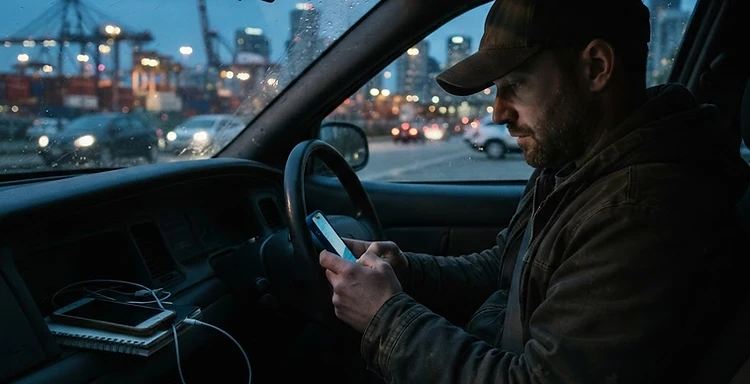
The counter-narcotics infiltration. An operative is placed inside a distribution network and spends months earning access to a mid-level figure. Tasking arrives encrypted. Two conversations that matter most happen in a vehicle with the radio on. Both are captured, hashed and stored off-device within minutes, with the capture tied to the case file and the device serial. When the network is dismantled, the recordings survive defence challenges about provenance because the custody path is documented rather than reconstructed.
The trafficking task force. A confidential human source is introduced to a network moving workers across borders. The source's safety depends on the network not learning who they are; the prosecution depends on being able to show what was said. The task force uses enrolled devices for the source's handler, keeps collection scoped to the authorised operation, and applies a retention schedule that discards material unrelated to the case. The evidence survives scrutiny precisely because the agency can show what it did not collect.
What oversight must exist before deployment
The capability is only defensible if the controls are real. Before any deployment:
- Written authority for the specific operation, with the legal basis named and reviewed by counsel.
- Proportionality and necessity assessments recorded before collection begins, not after.
- Judicial or independent oversight wherever the jurisdiction requires it, with the oversight body able to read the audit trail.
- Minimisation rules that define what must not be collected, and technical limits that enforce them.
- Retention and deletion schedules that are enforced by the system, not by memo.
- Immutable audit logs of access, export and deletion, reviewable by someone outside the operational unit.
- A disclosure plan for how captures will be produced to a court and to the defence.
The accountability tension, stated honestly
The same capability that protects an operative and preserves evidence can be turned on a journalist, a political opponent or a source who trusted the wrong person. That is not a hypothetical objection; it is the central lesson of the commercial spyware decade documented elsewhere on this site.
The difference between lawful field tooling and mercenary surveillance is not the technology. It is authority, scope and review. A system where every capture is attributable to an authorised case file, where the audit trail cannot be edited by the unit being audited, and where an independent body can inspect it is a different instrument from a product sold to whoever pays.
Agencies evaluating this class of platform should treat those properties as procurement requirements. Undercover Agent presents itself as an agency-operated system with delivered source code, on-premise deployment and independent audit — the right questions to ask are whether the audit logs are genuinely immutable, how minimisation is technically enforced, and what a court will see when the tooling itself is challenged.
An operation that produces arrests but no provable record has not succeeded. The measure of field technology is whether it survives the courtroom as well as the street.
Agency-operated command and control for enrolled field devices, agent protection and chain-of-custody evidence capture.
Visit undercoveragent.live